



If you’re even remotely on social media, you’ve probably seen the obsession with salt bread. And honestly? It deserves every bit of the hype.
Salt bread, or shio pan, is a Japanese bread roll that’s a hybrid between a dinner roll and a croissant. The magic is in the middle: a chunk of butter tucked inside the roll. In the oven, that butter melts and seeps out, frying the bottom of the roll as it bakes. Take just one bite into that crispy, buttery goodness and you’ll understand why everyone is hooked. I’m not exaggerating when I say I crave salt bread daily.
Bread making can feel intimidating, but salt bread actually isn’t that difficult to make. I let my trusty stand mixer do all the work, but you can absolutely knead it by hand if you’re up for a mini arm workout. That said, while salt bread is simple to make, it’s not simple to get right. Luckily, after plenty of trial and error, I’ve learned a couple of handy tips to ensure your rolls turn out golden, glossy and perfectly buttery.
TIP #1: Use ice-cold water
The problem that most people run into is dough stickiness. The best way to prevent this? Keep everything cold. Use ice-cold water and cold butter. If the dough temperature gets too high while kneading, the gluten weakens, and you’re left with a sticky mess. So, use ice-cold water, keep your butter chilled and if you’re feeling extra cautious, pop your mixer bowl in the fridge beforehand!
TIP #2: Just keep kneading
Whether you use a stand mixer or your hands, the dough will have to be kneaded for a long time. In a stand mixer, this could range anywhere from 15 to even 40 minutes. It sounds like a lot, but this process is crucial for gluten development. At first, the dough will seem impossibly sticky. Don’t fret! As long as you keep kneading, it will eventually transform into a silky smooth dough.
TIP #3: Roll tightly and be patient
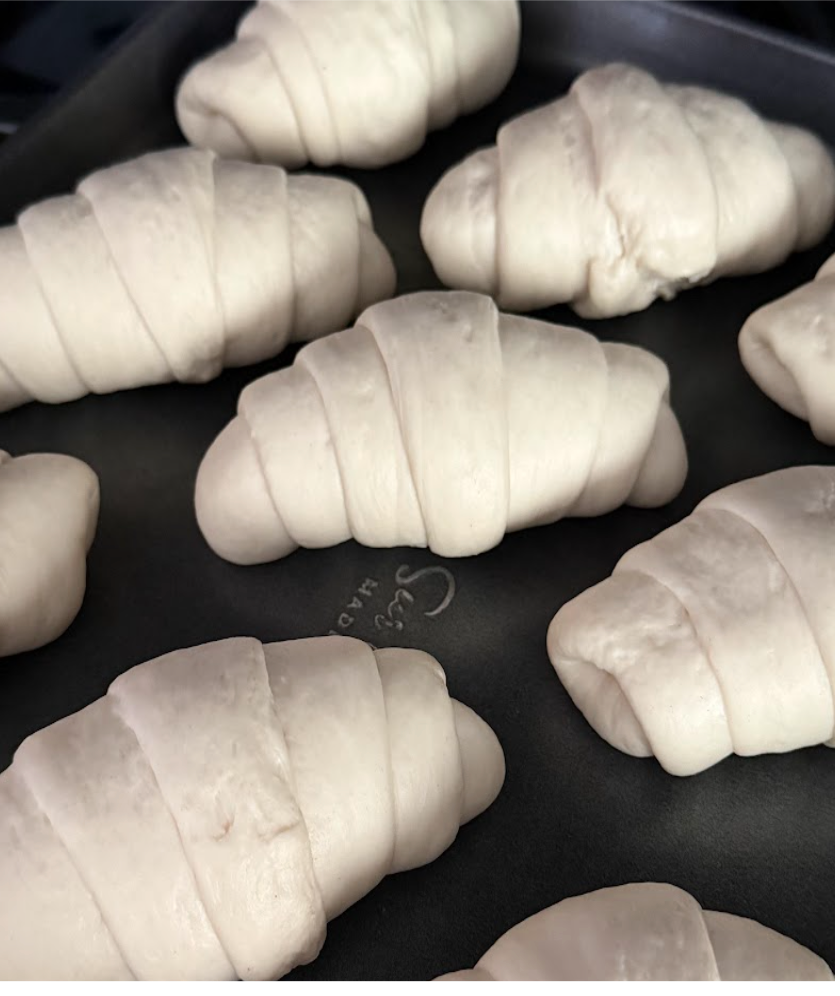
Now onto the shaping. This, I would argue, is the hardest part if you want your rolls to look picture-perfect. Before shaping, let the dough balls rest for at least 15 minutes. Do not skip this step! It allows the gluten to relax, making it easier to stretch out the dough into a long triangle. Then, after placing the chunk of butter at the wide end of the triangle, roll the dough towards its point, going slowly and gently tugging at the point for tension. This takes some practice!
TIP #4: Spray those rolls!
Right before baking, use a spray bottle to generously and evenly mist the rolls. This creates steam in the oven, helping the rolls develop that beautiful golden, glossy crust, making them look bakery-level irresistible.
TIP #5: Bake straight on the pan!
For the crispiest, fried-in-butter bottoms, bake the rolls directly on a dark non-stick baking pan. Forget the parchment paper. As the butter melts and seeps out, it pools in the pan and fries the bottom of the roll. This is the best part of the roll, just trust me on this one.
Now that you’ve got all the insider tips, it’s time to head to the kitchen. Whip up a batch, take that first crispy, butter bite and try not to fall in love. You can thank me later.