


For those who love to cook, it is a seductive sight to see all the produce available during the summer months. An even more ambitious contingent of people has begun to harvest bounty from their gardens. Perhaps you’re a lucky recipient of the ‘I grew too much…’ donations from a gardener friend. However you obtain your summer produce, maximize your dollars by using vegetables and fruits from root to stem. All too often, people discard delicious parts of their produce that are not only edible but also nutritious. With a little knowledge of how to utilize more of summer fruits and vegetables, we can help reduce food waste and stretch grocery budgets further. Shopping seasonally means purchasing produce that is significantly cheaper, fresher, and packed with more nutrients, so why not take advantage of it by maximizing its longevity?
While you can find them in supermarkets year-round, locally grown, hyper-sweet carrots are harvested from late spring through mid-winter. If given the option, always keep the leafy tops on your carrots because they absolutely deserve a place in your kitchen. Carrot tops contain dietary fiber, which helps regulate blood sugar and digestion. They are also a source of potassium, vitamin K, vitamin A, and vitamin C. Carrot tops have a slightly bitter taste, which works well to help balance soups, stews, salads, and braises. A popular way to use carrot tops in large volumes is to make a pesto. Augment the bitterness with a sweeter nut, such as pistachios or almonds, and source the umami notes from Parmesan cheese. Round out the dish with a few garlic cloves, fruity olive oil, and salt and pepper to taste. Blitz everything together in a food processor, blender, or mortar and pestle, and Voilà, you have carrot top pesto.
Another luxurious option for carrot tops is to create a carrot top pistou, which is France’s Provencal version of pesto. Unlike pesto, a pistou does not contain nuts or cheese, but some modern recipes call for a hard cheese such as Parmesan. Pistou is delicious as a dipping sauce or an addition to soups, such as the Provençal vegetable soup known as soupe au pistou.

An extremely versatile vegetable, Swiss chard is also in abundance this time of year. Like its superfood friend, kale, Swiss chard is high in fiber, vitamins such as K, A, and C, and minerals such as magnesium, potassium, and iron. Its rich antioxidant and fiber profiles support heart health, regulate blood sugar, build strong bones, and protect vision, earning Swiss chard a rotation in your culinary repertoire. When preparing Swiss chard, some recipes call for stripping the tender leaves from the inner stem, which has a texture similar to that of bok choy. The leaves are delicious and quickly wilt like spinach, creating a textural contrast with the tougher stems. However, chard stems can be easily braised and enjoyed as a side dish in their own right, or pickled, which will last 2-3 weeks in the refrigerator.

No conversation about summer fruits is complete without discussing strawberries, a darling of late spring and early summer harvests. Their candy-like sweetness in peak season ripeness has fans devouring the berries by the pint. Strawberries are delicious in tarts, galettes, cake fillings, and concentrated into jams and jellies. Despite the preparation, a common image of using strawberries as an ingredient is the inevitable pile of strawberry tops, which are frequently discarded as useless. Happily, strawberry leaves and stems are perfectly edible and nutritious. They are high in vitamin C and anti-inflammatory polyphenols, which act as antioxidants in the body and may help reduce the risk of cancer, cardiovascular disease, and diabetes. Strawberry leaves and stems are a nutritious addition to smoothies and salads, but they are also delicious steeped as a tea. Additionally, strawberry tops can be cooked down to make a simple syrup, which can be used as a dessert topping or a sweet addition to drinks such as tart lemonade, cocktails, and mocktails. So, the next time you’re eating strawberries, why not benefit your body and your wallet by using the tops of your strawberries in creative and delicious ways?
This summer, as you’re preparing produce, do a little research to see which parts of your fruits and vegetables are edible, and don’t automatically discard the unknown bits. You’ll not only make your purchases more economical, but you’ll also benefit from the added nutrition you may not have known was at your fingertips. With a little creativity, you can discover new ways to enjoy making the most of summer produce by using vegetables and fruits from root to stem. After all, you paid for all of the parts that came home with you, so why not eat what you can?
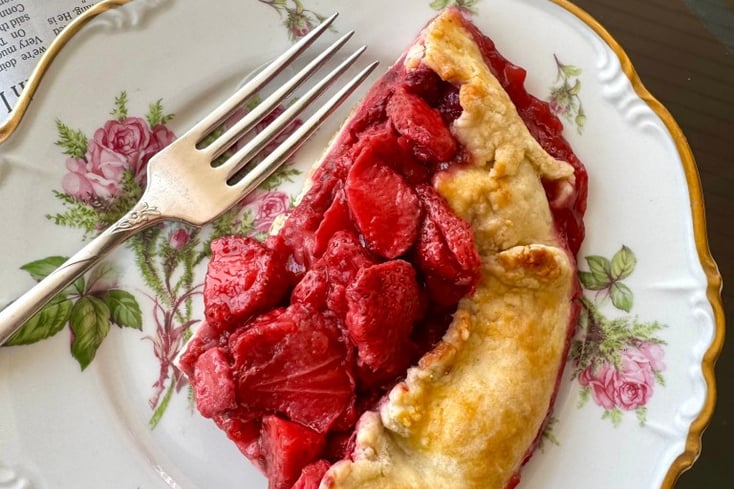

Strawberry Galette & Strawberry Top Simple Syrup
Strawberry Galette
Strawberry Top Simple Syrup
- Place the flour, sugar, and ¼ tsp salt in a bowl. Add the cubed butter pieces and cut the butter into the flour using a pastry blender or your fingers until the chunks look slightly smaller than pea-sized. Toss the butter slices with the flour mixture, separating them as you go, then gently press them into the flour between your fingers to flatten them.
- Slowly add the ice water several tablespoons at a time until the mixture comes together. Pour onto a work surface and form into a ball, and then flatten into a disc. Cover in plastic wrap and refrigerate for at least 1 hour and up to 3 days.
- While the dough is chilling, mix all of the remaining ingredients in a bowl and mix to combine.
- Preheat the oven to 400 degrees F. When the dough is chilled, place some flour onto a work surface and roll it out into a 12-inch round that is approximately ¼ inch high. Transfer the dough by folding it over a rolling pin and placing it onto a baking sheet lined with parchment paper.
- Fill the center of the dough with the strawberry mixture, leaving behind any liquid that has collected in the bowl.
- Fold the border over the fruit, pleating the folds over one another. Leave the center fruit exposed. Pour in some of the reserved liquid, but do not overly saturate the dough.
- Fold the border over the fruit, pleating the folds over one another. Leave the center fruit exposed. Pour in some of the reserved liquid, but do not overly saturate the dough.
- Brush the dough with the egg and sprinkle it with sugar.
- Bake for about 35 minutes or until the crust is golden brown. Some juices may leak, which is normal. Brush the strawberries in the warm galette with the strawberry jam. Cool on a wire rack for 1 hour and serve with vanilla ice cream.
- Place the strawberry tops in a small pot and add enough water to cover them.
- Bring the water to a boil, then reduce to a simmer. Simmer for 1 hour, or until the strawberry tops are pale and the water has turned crimson.
- Strain the liquid into a glass measuring cup and discard the tops.
- You should have approximately 2 cups of strawberry liquid. If you are short, add water to reach 2 cups.
- Carefully pour the liquid back into the pot and add the sugar. Simmer the mixture over medium-low heat until the sugar is fully dissolved, about 1-2 minutes. Stir to help dissolve any remaining sugar granules.
- Remove the pan from the heat and let the syrup cool to room temperature. Store it in an airtight container or a sealed glass jar in the refrigerator for up to two weeks.
Strawberry Galette
Strawberry Top Simple Syrup
Notes
- Typically, the ratio for a simple syrup is 1:1 sugar to water. If you would like to make a rich simple syrup, the ratio is 2:1 sugar to water. In a rich simple syrup, the higher sugar content acts as a natural preservative, allowing it to last 3–6 months.
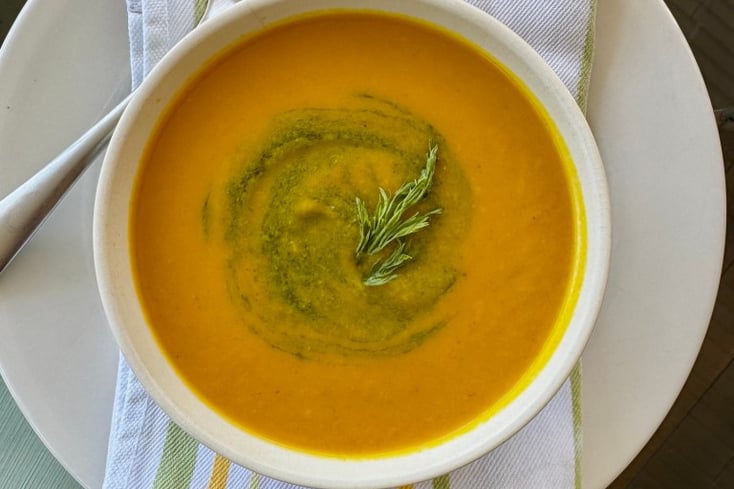

Carrot & Ginger Soup With Carrot Top Pistou
Carrot Top Pistou
Carrot Soup
- Place all of the ingredients in a blender, food processor, or a container safe for a hand blender and puree until fully incorporated.
- In a heavy-bottomed soup pot, heat the olive oil over medium heat. Add the coriander, cumin, ground ginger, curry, and turmeric and toast until the spices are fragrant.
- Add the ginger and garlic and cook until they become fragrant but have not taken on any color, approximately 20 seconds.
- Add carrots, celery, and onion and cook until they look wilted but not browned, approximately 2-3 minutes.
- Add the vegetable stock and bring the soup to a boil, cover the pot, and reduce the heat to low. Cook until the carrots are tender when pierced, approximately 15-20 minutes.
- Turn off the heat and let the soup cool slightly. Puree in a blender in batches, filling the blender ¾ of the way to the top. Remove the small inner core of the lid and place a dish towel over the top of the lid. Puree soup until smooth.
- Reheat pureed soup over medium heat and stir occasionally. Adjust salt and pepper if needed.
- Transfer soup to bowls and top with 1-2 tbsp of the carrot top pistou.
Carrot Top Pistou
Carrot Soup
Notes
- You do not have to peel your carrots for the soup, but make sure they are rinsed well in order to remove any grit.
- For a spicier soup, add additional ginger or cayenne pepper.
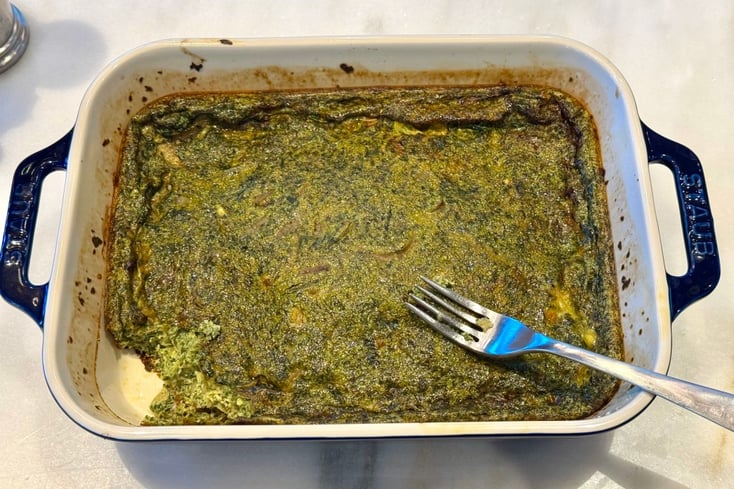

Swiss Chard Leaf Frittata
- Preheat the oven to 375 degrees F. In a large, high-sided skillet, such as a cast iron pan, heat the butter and olive oil over medium heat. When the butter begins to foam, add the onions and cook until they wilt and begin to brown. Add the garlic, stir into the onions, and cook until fragrant, about 30 seconds.
- When the onions are ready, add the Swiss chard and cook until it wilts down by half. Season with salt and pepper.
- Add the Parmesan cheese and mix to combine.
- Place the Swiss chard mixture into a bowl and allow it to cool for 10-15 minutes
- In a separate bowl, mix the eggs, milk, salt, and cheddar cheese and pepper to taste.
- Add the Swiss chard mixture to the eggs and stir to combine. Add the egg mixture to the skillet and bake for 30-35 minutes or until the eggs have set in the middle. Let the frittata cool for 10 minutes before eating. It can also be enjoyed at room temperature.
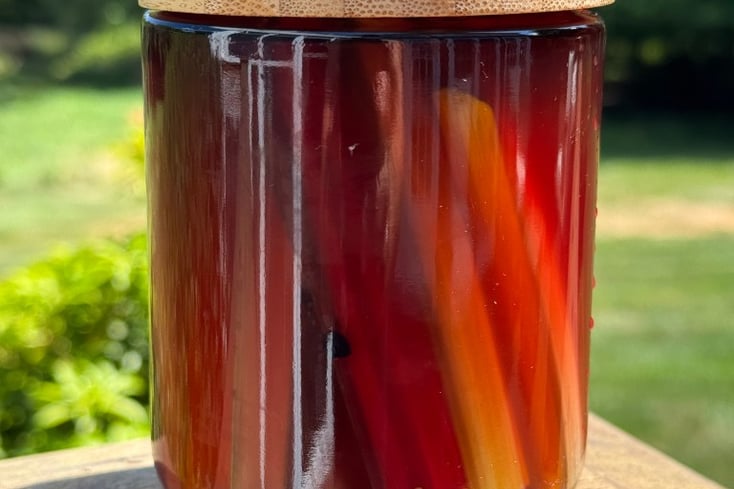

Pickled Chard Stems
- In a large Mason or heatproof jar, place the chard stems so they fit snugly inside.
- Make the brine by combining the vinegar and sugar. In a small pot, bring the water to a boil, then immediately remove from the heat and add to the vinegar, salt, and sugar mixture. Stir until the sugar and salt are dissolved, and add additional flavorings if using. Let the mixture cool for ten minutes.
- Carefully pour the brine over the chard stalks, cover, and refrigerate for at least 2 days before eating. The pickles can be refrigerated in an airtight container for up to 2 weeks.
Notes
- For additional flavor profiles, try adding combinations of ingredients such as mustard seeds, peppercorns, garlic, herbs, and juniper berries.